
Discussions continue on essential EMS service
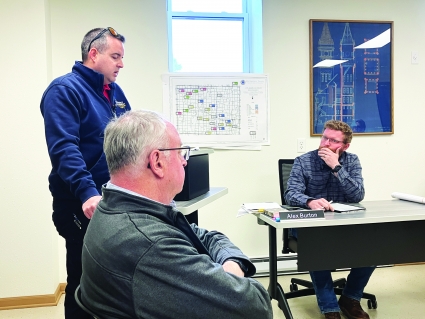
The Montgomery County Board of Supervisors is continuing conversations regarding declaring emergency medical services as essential.
At the May 5 meeting, during public comment, Villisca City Council Member Tripp Narup said he was pleased the county was keeping the conversation going.
“As I’m finding out the more people I talk to, it’s a complex issue. It involves county government, several city governments, townships, multiple hospitals, volunteer EMS folks, and paid EMS folks, and I’m probably leaving some folks out there,” advised Narup. “It’s not going to be an easy solution, I know that already just from the people I’ve talked to. It’s going to take a lot of work on all of our parts, but it all starts with the supervisors. You guys start the ball rolling, and I appreciate the fact that you’re willing to talk about it and to hopefully start things moving.”
Red Oak city administrator Lisa Kotter also spoke before the supervisors and shared Narup’s sentiment about county-wide EMS being back under discussion.
“Tripp and I talked after the meeting and I am working on a 28E agreement for communities. Montgomery County Emergency Management coordinator Brian Hamman and I also met last week. We’re hopeful that we can try to get some sort of transitional time agreement with everybody,” commented Kotter. “I would agree with everything that Tripp says, it does lead from you. I also want to encourage you to not try to rush it. It really needs to be done well the first time. I wouldn’t see anything going before any sort of vote until 2027, to make sure that you give all the communities along with county representation the time to go through that. Hopefully, we can work on that. We’re certainly more than willing to be involved in that conversation.”
The supervisors then moved into discussion on essential EMS services. Hamman said he had shared information regarding pertinent Iowa codes.
“The three major codes are Iowa code 422D, 357F, and 357G. Iowa Code 422 is basically a funding mechanism. It’s not a service structure, it’s strictly for funding countywide EMS. It allows the county to deem EMS as an essential service, therefore allowing you as the county board of supervisors to go to referendum for the vote to add that property tax up to 75 cents per thousand dollars. It does require a 60% voter approval, which I think is going to be the biggest challenge and the biggest hurdle. Obviously, those funds can be dedicated to anything EMS-wise that the code allows,” Hamman stated.
As he did research, Hamman said he talked to some other counties that have been successful, counties that have not been successful, and the different things that they’ve done, and Hamman said Iowa code 357 was the code that was consistently brought up.
“Obviously, it’s an older way to fund EMS, either city-based EMS or through local townships. As Tripp said, I think we can all agree our situation is unique. Every county is unique, whether it’s a hospital-based EMS system or a contracted service or the county creating a completely new service. I mean, the information that we’ve got is across the board. There’s no one county that’s the same,” said Hamman. “I did talk to a county that is on year three of their journey, and they’re nowhere close. I will also say that county is very close to ours with the makeup between volunteer services, the hospital transfer issue, as well as municipal fire departments running the ambulance. The unique thing with that county is they have two full-time municipal fire departments. So these are some things to think about, and things to look at. Obviously, there’s a lot more research that needs done.”
As for the potential for trying to move the issue towards a vote in the upcoming general election in November, Hamman had his doubts.
“I don’t think there’s any way possible for it to proceed to where we are at the best chance that we need to get it approved. Obviously, we have hurdles. There’s the tax issue with the Red Oak residents. There’s also the issue with our EMS districts. All but one go on to adjoining counties. So, the case could be set for those voting to approve or deny, ‘Is that fair for us in the county to approve this when those in outlying counties are not going to pay for the tax, essentially?’ Again, these are just some things to think about. Obviously, this is early on. I think the discussions that we’ve had so far has been good, but we need to have a lot more discussion.”
Hamman added that how that makeup is done and how it goes forward is really up to the supervisors, up to the cities, and up to the agencies because it was everyone’s issue. Hamman also had a few suggestions on where the county could start on branding EMS an essential county service.
“I think our biggest issue is defining what the true need is. In my eyes, we have two needs. We have the money issue, those financial needs, and we have the people issue. I think the money issue can be decided with one of these, potentially, but it’s the people issue that’s the biggest hurdle. Volunteerism is down, everyone knows that, no matter what it is. We have a small applicant pool. trying to find people in the small communities that are available that want to help out is a challenge,” said Hamman. “Additionally, training is a challenge, and continuing education is a challenge. I think the the first big step involves sitting down with these groups and really discussing what our needs are, and potentially what the future looks like. I hate to see a Villisca or Stanton lose their ambulance in the next five to 10 years, but what’s the reality? Is that a possibility? It needs to be discussed.”
Supervisor’s Chair Charla Schmid agreed with Hamman’s assessment that rushing things to a vote in November of this year was likely not the way to go.
“I think back to school board bond issues. Even when everything was well-presented and researched, sometimes the votes still took a couple of times before they were approved. To me, I think it’s better to educate everybody and get everything together first, with meetings organized so we can figure out exactly what we need,” commented Schmid.
Hamman said while he had researched Iowa Cote 422D, it may not be the best for what the county needed.
“Maybe 422 isn’t the way to go. Maybe one of the 357s on the county side for the townships is the way to go, but if a Villisca, or Stanton, or Grant goes that route, they’ve got to go not only to our county, they’ve got to go to all of the counties that they have coverage areas in. Villisca, for example, they’re in four separate counties,” advised Hamman.
Supervisor Bryant Amos was also in favor of not rushing to meet the 2026 election deadline, but felt that from this point on, the supervisors board needed to constantly be moving towards it so that the 2027 election deadline did work, and they weren’t in a situation where they had made no progress at this same time in 2027.
As far as Iowa Code 357F and G, Hamman explained to the supervisors that they were basically the same code.
“One revolves around the county and the townships. The other one is city-based EMS. So 357F is the county or regional EMS districts, which basically creates a benefited EMS district for that service area. It’s created and governed by the county board of supervisors. It covers the unincorporated areas and townships. Therefore, it would have its own elected trustees, a tax levy, and the ability to issue bonds. This would function as a standalone EMS service area,” Hamman explained. “357G is a city-based EMS district. This would be strictly the incorporated areas of the city of Red Oak if they were to go that route on an EMS district. And that is run by the city council versus the board of supervisors. There are differences and takeaways, but basically, it’s going to come down to what fits best for our uniqueness in Montgomery County. They all have benefits, and they all have minuses.”
While moving forward with Iowa Code 422D would require a 60% majority for approval, it was Hamman’s understanding that Iowa Codes 357F and G could pass by a simple majority.
Schmid said they had discussions on a committee and wanted to get Hamman’s ideas on what the commission needed.
“I did ask around when I did research with some of the other counties, and it’s across the board. Some counties, it’s a representative of just their fire department or ambulances, an elected official, whether it’s city council, board supervisor, and that’s their group. Others, they have a committee of about 20 or 30 people. If it gets that big, it creates its own issues,” stated Hamman. “In my eyes, I think the ambulances need to be represented directly because this is who it affects. Obviously we also need representation by the the city councils to an extent, because that’s where the funding issue is. I don’t discount the fact that this is a funding issue, but we have a severe people issue.”
Supervisor Alex Burton felt the county could have a committee that’s smaller, and then ultimately have a subcommittee of a larger demographic to capture their voice without having an overly large committee creating issues.
As for the lack of volunteers, some of the issues arose from the fact that the volunteers who were committed often had to work out of town.
“Red Oak, for example, years ago, a lot of the volunteers that we had during the day you could count on because they were employed at some of the factories. A lot of those factories aren’t here anymore, and those factories that closed had allowed them to leave for certain calls.At the time that benefited, obviously, the fire department when we had calls during the day, but we don’t have those anymore. Everyone’s busy. And it’s just not fire service.
It’s everything across the board. You see it with the schools, the PTOs, everyone’s hurting,” said Hamman. “It is an issue. I would like to see it corrected, but it’s going to take some serious time and effort.”
Discussions also took place on whether the committee should be appointed and fall under open meetings laws, or be a volunteer committee which wouldn’t have those same requirements. Kotter erred on the side of transparency.
“I think from my perspective, if it was under the city, everything that you do needs to be transparent. It might be difficult conversations, but it really needs to be a subcommittee of the board that you appoint and would be subject to all open meeting laws. There’s people that think if two of you are on a board that you’re not a quorum, but if you’re on a subcommittee that’s appointed, you’re still a quorum of that committee. I would even post the agendas in your shoes, just be transparent,” commented Kotter.
Under the discussion, it was also stated that the hospitals also needed representation on the potential committee. Hamman was directed by the supervisors to reach out to the communities in the coming weeks to begin to form the proposed committee.